Ask someone what davit crane they need and you'll get a number back.1200lbs. 2500. It's the first line on every spec sheet, so it feels like the responsible place to start.
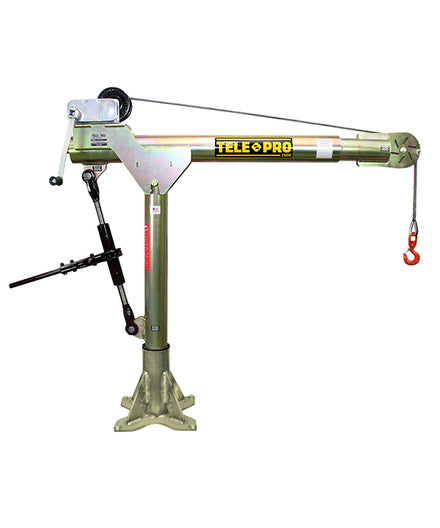
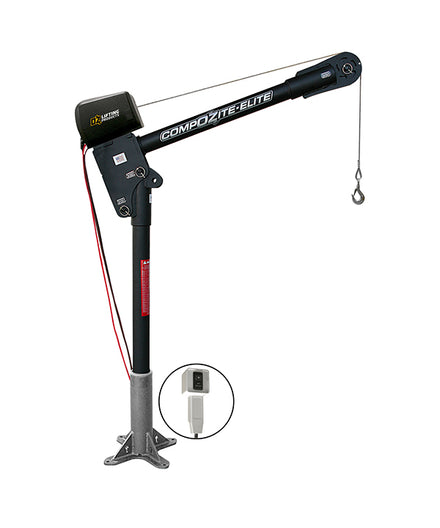
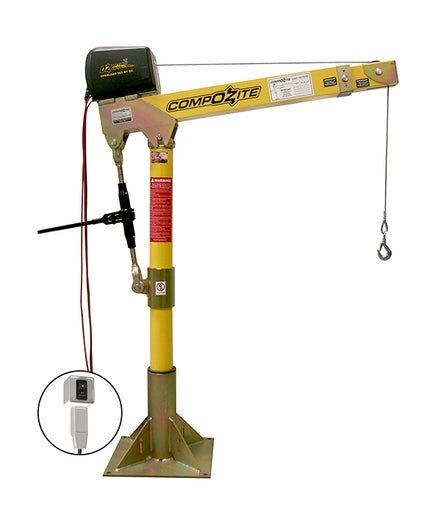
Here's the problem. In the OZ Lifting range we stock, three different cranes are rated at 1,200 lb — the Compozite, the Compozite Elite, and one configuration of the Tele-Pro. Different materials, wildly different weights, completely different adjustment, and over a thousand dollars between them.
Same number. Three very different pieces of equipment.
Capacity gets you into the right neighbourhood and then stops helping. This guide covers what actually narrows it down.
What is a Davit Crane?
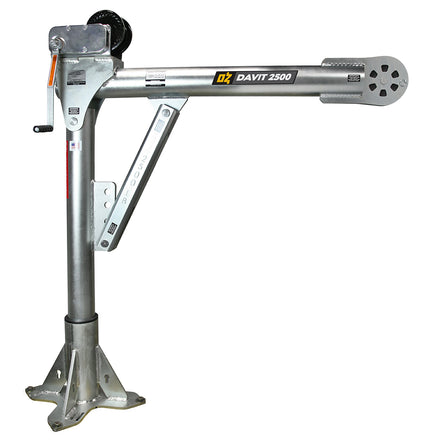
A davit crane is a compact, rotating lifting device made up of a base, mast, boom arm, winch, and a rope or cable assembly ending in a swivel hook. It mounts into a fixed base — pedestal, socket, or wall — and typically rotates 360° to move a load between two points.
The simplicity is the point. A davit fits where a bigger crane can't, needs no permanent structure beyond its base, and can usually be lifted out and carried elsewhere.
You'll find them pulling pumps from wet wells at wastewater plants, on rooftops handling HVAC components, at confined space entry points, and anywhere the lift is real but infrequent.
("Davit arm" and "davit crane" get used interchangeably. Strictly, the davit arm is the boom; the crane is the whole assembly.)
Davit, Jib, or Gantry?
Worth settling first, because if you're in the wrong category nothing below matters.
| Davit crane | Jib crane | Portable gantry | |
|---|---|---|---|
| Installation | Base only | Permanent column or wall | Freestanding |
| Footprint | Very small | Small but fixed | Large |
| Relocatable | Yes, often by one person | No | Bulky |
| Typical capacity | 500–2,500 lb | 250 lb–5 ton+ | 500 lb–5 ton |
| Best for | Occasional lifts, awkward or multiple locations | Repeat lifts at one workstation | Anywhere on a flat floor |
If the same lift happens in the same place all day, buy a jib — it'll be faster and cheaper per lift. If there's nothing to mount to and you have floor space, buy a gantry. Davits win on access and flexibility, and lose on cycle speed.
The capacity trap
Capacity matters. But it's a filter, not a decision — and it fails as a decision for three reasons.
It barely narrows anything. Most of the range clusters between 500 and 2,500 lb. Unless you need 2,500 lb, capacity leaves you with roughly the shortlist you started with.
The number you're working from is probably wrong. Your real load includes the object weighed (not estimated), all rigging — slings, shackles, spreader bars — plus dynamic forces from starting, stopping and swinging. And a boom rated at its shortest reach is not rated the same at full extension. That last one is the most common misreading of a spec sheet.
The system derates to its weakest part. Worth stating bluntly: A 2,500 lb winch fitted to a 1,200 lb crane still only lifts 1,200 lb.
Capacity is set by the lowest-rated component — crane, winch, cable, hook, base, and the structure it's bolted to. Upgrading one part doesn't upgrade the system.
So get an honest weight, add your rigging, check the rating at the boom position you'll actually use. Then start asking the questions that decide things.

1. How far does someone have to carry it?
This is the question that gets skipped, and it determines whether the crane earns its money.
A davit that's too heavy to reposition doesn't get repositioned. It stays put, and people compensate — overreaching, side-loading the boom, rigging at an angle to reach something the crane can't quite get to. All worse than the thirty seconds of walking it over would have cost.
So be honest about the pattern of work:
- One fixed location. Weight barely matters. Buy on capacity and reach — get the steel.
- Several mount points around one site. The common case, and weight matters a lot. Someone is carrying that mast across a facility.
- Between vehicles and jobsites. Weight dominates. A crane needing two people and a tailgate lift is a crane that stays in the yard.
The range splits cleanly:
- Compozite Elite — carbon fibre and aluminium, 37 lb, still 1,200 lb rated, one-person tool-free assembly.
- Compozite — advanced composite boom and mast, ~40% lighter than steel, 1,200 lb, also tool-free.
- Steel Davit Crane — zinc-plated, 500/1,000/2,500 lb. The right answer when nobody's carrying it anywhere.
The trade-off, plainly: the Elite costs roughly three times the Steel. If your crane lives in one place, that premium buys you nothing. If two people currently wrestle a mast across a plant twice a week, it pays for itself in a way no spec sheet captures.
2. Will the boom need to move mid-lift?
Most davits offer fixed boom positions — the Steel and Compozite both give four height settings, adjusted between lifts. Fine for most work.
It stops being fine when a lift doesn't go to plan. You're lifting to a rooftop and the load catches on the parapet. With a fixed boom, the only safe response is to lower it, land it, readjust, re-rig, start again. That's the point in the job where people get impatient and improvise.
The Tele-Pro exists for this — a patented telescoping boom that extends and retracts under load, driven by the winch handle or a drill adapter. The load stays put; the reach changes around it.
Worth it if lift points vary between jobs, clearance changes partway through, or you're threading loads past obstructions rather than lifting into open air.
The catch: the crane must be rated for the load at every boom position you use, not just the shortest. Know the chart before you're standing there holding a suspended load.
3. What is the environment doing to your crane?
Material choice is where you either pay upfront or pay later in replacement.
| Environment | Sensible build |
|---|---|
| Indoor, dry | Zinc-plated steel, galvanised cable |
| Outdoor, general | Aluminium or composite, galvanised or stainless cable |
| Wastewater / water treatment | Composite, stainless or synthetic cable |
| Marine / coastal | Composite or stainless, stainless or synthetic cable |
| Frequent outdoor relocation | Composite or carbon fibre, synthetic cable |
The key distinction: composite and carbon fibre are corrosion-proof, not corrosion-resistant. Coated steel fails wherever the finish gets damaged. That's why composite dominates in wastewater — the crane sits in an atmosphere that eats plated steel.
Same logic for what hangs off it. Galvanised cable is standard; stainless earns its premium in marine and chemical environments; synthetic rope doesn't corrode at all and is far lighter to handle.
If the crane lives outside, a winch cover is about $40 against a component costing several hundred. That maths isn't close.
4. Manual, drill-driven, or electric?
This is about frequency, not weight.
Manual — standard across the range, DIN-rated with a load-holding brake. Best control, no power needed, cheapest. The problem is human: cranking through repeat lifts is tiring, and tired operators take shortcuts.
Manual with drill drive adapter — included as standard on most of these cranes and quietly the best value in the range. Fine control by hand when you need it, a cordless drill when you just need 40 feet of cable in. Removes most of the fatigue argument for no extra cost.
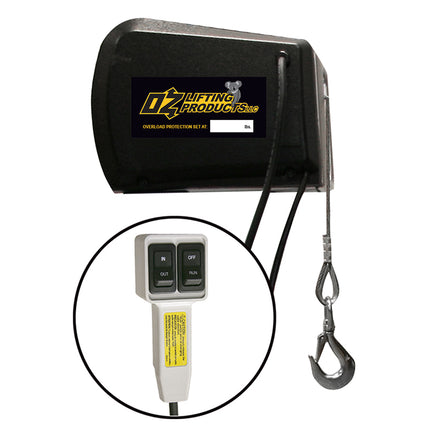
Electric, 110V AC or 12V DC — for repetitive lifts, longer lift heights, and where consistency beats granular control. Adds roughly $900+, so it wants justifying — but on a weekly-use crane it justifies itself fast.
Rough rule: occasional → manual. Weekly → manual with drill adapter. Daily or deep lifts → electric.
5. Which base, and is the structure ready?
- Pedestal — bolts to the floor, general-purpose choice.
- Socket — sits flush with the floor, so nothing to trip over or drive into when the crane is out.
- Wall / parapet — when floor space is gone. Common on rooftops.
- Wheel — moving loads around a facility rather than between fixed points.
Two things to get right. Bases are series-specific — Elite, Compozite and Tele-Pro each take their own, roughly $80 to $340 depending on series. Within a series they're interchangeable, so one crane can serve several installed bases with no tools. That's the setup worth aiming for.
And check what you're bolting into — concrete depth and reinforcement, wall construction, roof structure. Verify before ordering, not after the crane arrives. It's the most common source of delay we see.